
Carpenter Ant Exterminator in Quebec Identification, Damage and Treatment
One large black ant on the counter on a spring morning, then a small pile of sawdust at the foot of a door frame: those are usually the first signs of a carpenter ant infestation. Unlike a termite, a carpenter ant does not eat wood. It excavates it to tunnel out galleries and house its colony.
Over a few seasons, the colony weakens the framing and the beams of your property. There is only one way to get rid of carpenter ants for good: destroy the queen and the nest at the source. That is the work of a certified carpenter ant exterminator.
Divisions serving you across Quebec
Find your Pestora division and reach the team closest to you for your carpenter ant treatment. Fast response everywhere in Quebec, with 24/7 priority and emergencies often handled within 24 hours.
Pestora Greater Montreal
300-204, rue du Saint-SacrementMontréal, QC H2Y 1W8 (514) 546-2050 View division
Pestora West Island
3551, boulevard Saint-CharlesKirkland, QC H9H 3C4 (514) 546-2050 View division
Pestora Lanaudière
2800, boulevard des EntreprisesTerrebonne, QC J6X 4S8 (514) 546-2050 View division
Pestora Laurentians / North Shore
2175, boulevard de la TraverséeSaint-Jérôme, QC J7Y 0T2 (450) 516-8858 View division
Pestora Gatineau / Outaouais
555, boulevard Saint-JosephGatineau, QC J8Y 4A1 (819) 991-4447 View division
Pestora Trois-Rivières / Mauricie
1285, rue Notre-Dame Centre, bureau 1Trois-Rivières, QC G9A 0A0 (819) 991-4447 View division
Not sure which division? — Call us at (514) 546-2050
How to identify a carpenter ant
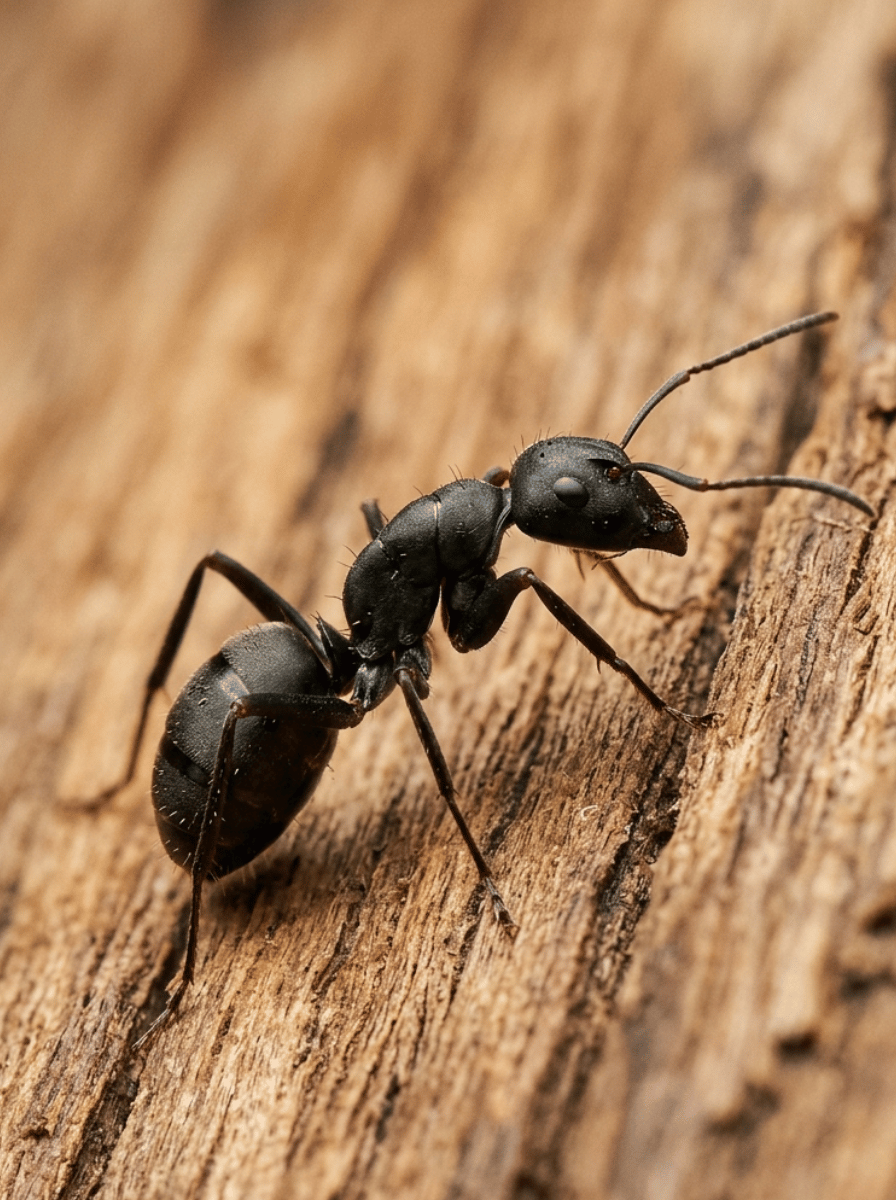
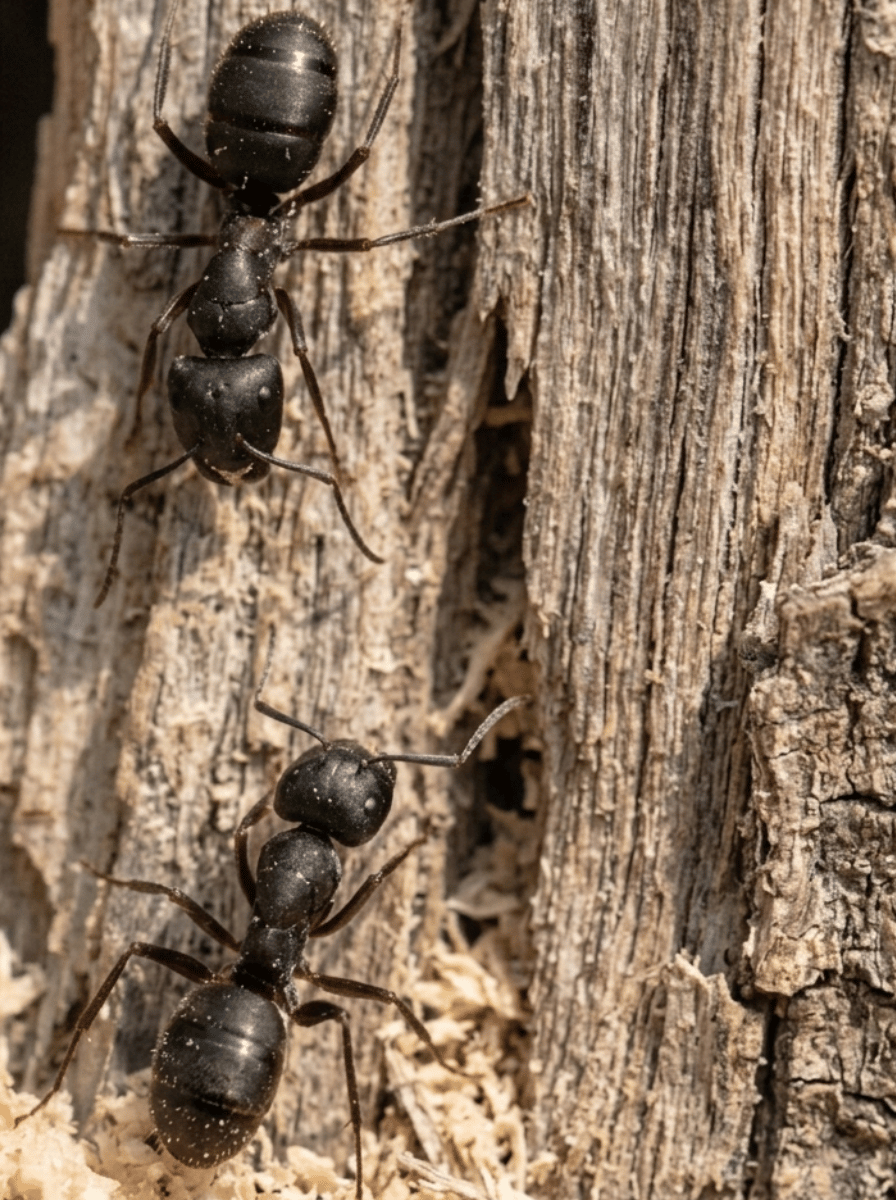
The carpenter ant found in Quebec, most often Camponotus pennsylvanicus, is the largest ant in the province. Here is how to recognize it and tell it apart from the common black ant and the pavement ant.
Size
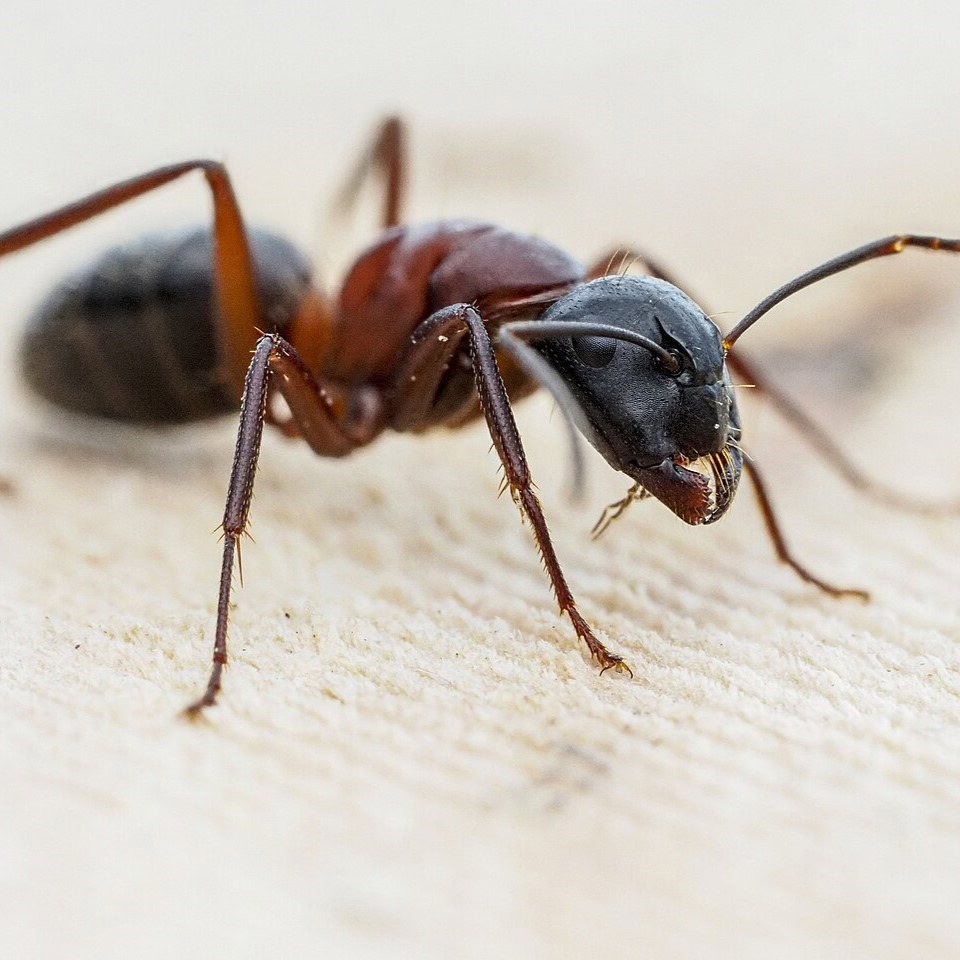
Between 6 and 13 millimetres, which makes it the largest ant species in Quebec. Within a single colony, workers vary in size depending on their role.
Colour
Solid black in the most common species, Camponotus pennsylvanicus, sometimes with dark brown or reddish tones. This is the classic large black ant people spot indoors.
Arched thorax and elbowed antennae
Body segmented in three parts, narrow waist, elbowed A body in three segments, a narrow waist and elbowed antennae. The thorax, smooth in profile and evenly arched, is the detail that identifies a carpenter ant at a glance.
Winged ants and swarming
In the spring, a mature colony releases winged ants, the reproductives, for swarming. Their four wings are unequal, the front pair longer than the back pair.
Carpenter ant or common black ant?
The small black sidewalk ant does not attack wood and nests in the soil. The carpenter ant is clearly bigger, tunnels into damp wood and leaves sawdust behind, and it is the one that threatens your structure. When in doubt, an inspection settles it quickly.
The signs of a carpenter ant infestation
Carpenter ants work at night, and quietly. By the time the signs are obvious, the colony often counts thousands of workers and several satellite colonies. Here is what to watch for in your home.
Sawdust and frass
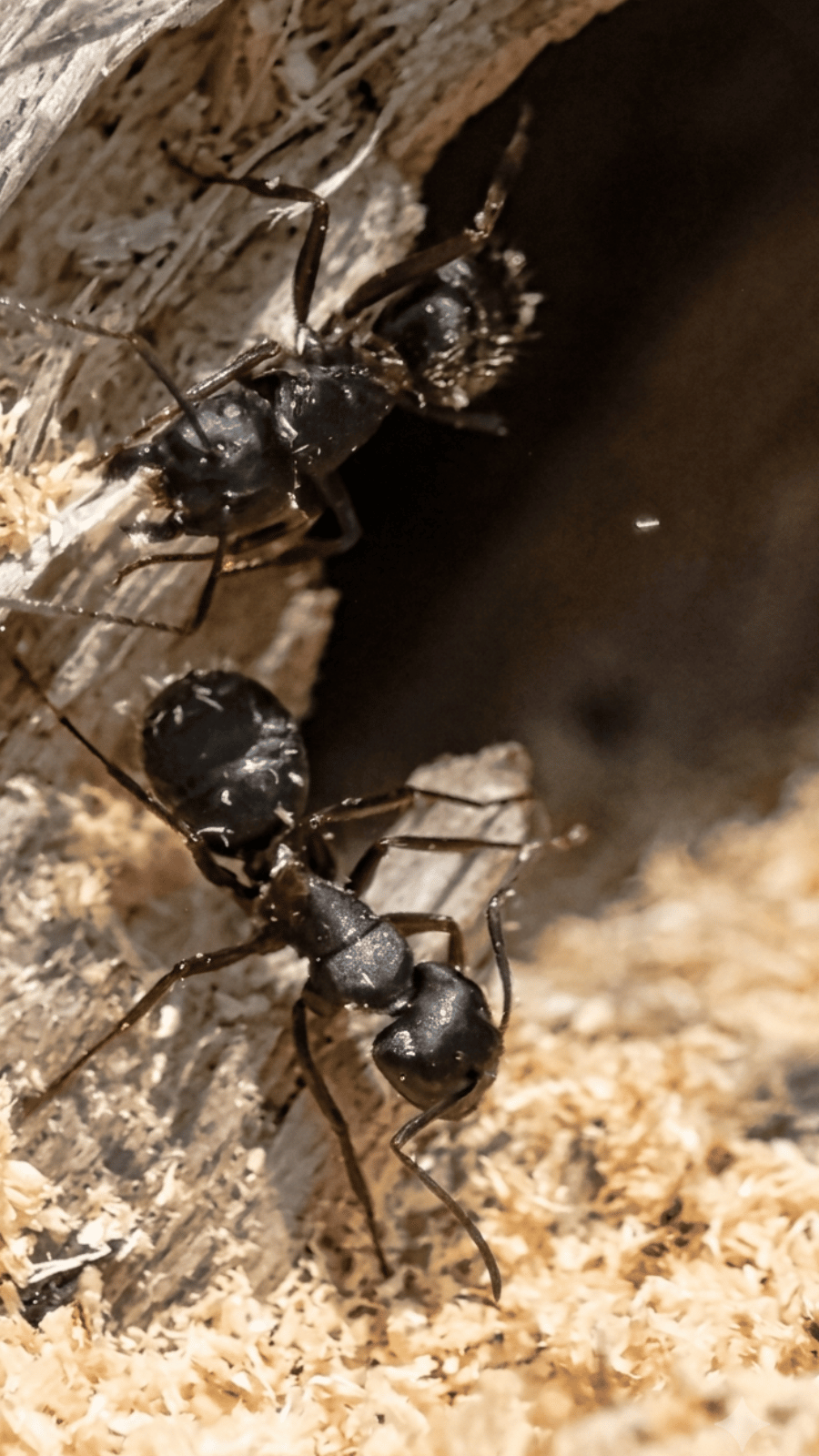
Small mounds of fine sawdust, known in the trade as frass, often mixed with insect fragments, near baseboards, window frames or beams. Frass is the most reliable sign of active excavation.
Rustling sounds in the walls
A faint crackling, close to the sound of crumpling paper, audible at night in the walls, the floors or the ceilings. That is workers cutting their galleries through the wood.
Winged ants in the spring
Winged ants indoors between April and June give away a mature colony: the reproductives are leaving to swarm and to found new nests.
Large black ants in plain sight
Large black ants showing up regularly in the kitchen, the bathroom or the basement point to a carpenter ant nest very close by. A lone ant may be passing through, but a trail means a colony is settled in.
discreet intervention
Where carpenter ants hide: parent nest and satellite colonies
A colony runs on a parent nest, outdoors, which holds the queen, plus one or more satellite colonies established inside your structure. To eliminate carpenter ants, both have to be treated.
Outdoor
The parent nest
The core of the carpenter ant colony, queen included, is almost always outside and often less than 100 metres from the affected house:
- A stump, a log on the ground or a dead limb on a living tree
- A cord of firewood stacked against the house or the shed
- A fence, patio or deck in contact with the soil
- Damp, partly rotted wood, which is what the colony looks for above all
Indoor
The satellite colonies
Carpenter ant satellite colonies branch out inside the house, above all where water gets in:
- Joists, studs and floors weakened by a leak
- Window frames, door sills and dormers
- Basements, crawl spaces and the area around plumbing runs
- Attics and roof sections that have leaked before
By tunnelling their galleries through damp or damaged wood, carpenter ants slowly weaken beams, joists and framing. Their galleries are smooth and run parallel to the grain, which sets them apart from the mud-packed tunnels of termites, a rare pest in Quebec.
Whether the affected wood belongs to a home, a business or an industrial building, carpenter ant damage keeps spreading as long as the colony survives. An advanced infestation can even qualify as a latent defect when a property is sold.
In Quebec, carpenter ants alone cause more residential structural damage than every other insect combined.
The Pestora method for eliminating carpenter ants
Four structured steps to wipe out the full colony, queen included, and prevent any return. Surface spraying on its own never solves a carpenter ant nest.
01/ Inspection
We inspect damp zones, framing, water points and the outside perimeter of the property. Our MELCCFP-certified technicians look for frass, galleries and active worker trails.
02/ Identification and nest location
We identify the species precisely, then locate both the outdoor parent nest and the indoor satellite colonies. Successful carpenter ant control starts with getting the location of the colony right.
03/ Treatment targeted at the queen
We apply bait and non-repellent insecticides approved by Health Canada. Workers carry the product back to the queen, the only target that matters: without her, the colony dies out.
04/ Follow-up and guarantee
A control visit two to three weeks later confirms the colony is gone, along with prevention advice and the written guarantee handed to you before treatment.
How to prevent a carpenter ant infestation
Carpenter ants settle wherever they find damp wood and an easy way in. Three habits cut the risk of infestation sharply and discourage the colony.
Get rid of the moisture
Repair roof, gutter and plumbing leaks, ventilate the basement and the attic, and replace water-damaged wood. With no damp wood on offer, your building is far less attractive to a colony.
Keep wood away from the house
Do not store firewood against the foundation, pull stumps and dead trunks off the property, and cut back branches touching the roof or the walls.
Sealing the entry points
Seal foundation cracks, the perimeter of windows and door frames, and the openings around pipes and wiring. This sealing and exclusion work cuts the routes carpenter ants use to reach the wood inside.
As long as the queen survives in the parent nest, the colony rebuilds itself, season after season.
Vigilance
Other pests to watch for in Quebec
Carpenter ants are only one of the species our exterminators treat across Quebec.
Cockroaches
They contaminate food and surfaces, and they breed at speed.
Cockroach exterminationBed bugs
A serious health and psychological risk, with treatment often spread over several visits.
Bed bug exterminationHouse mice
They chew wiring, soil insulation and multiply through the cold months.
House mouse exterminationSee every insect we treat
Pavement ants, pharaoh ants, spiders, earwigs and more.
See all insectsFrequently asked questions about carpenter ants
Do carpenter ants eat wood?
No. Unlike termites, they do not feed on wood: they excavate it to cut their galleries and house the colony. They feed instead on other insects, on sap and on sugary matter. The damage is mechanical, but the effect on your framing is very real.
How do you tell a carpenter ant from a termite?
The carpenter ant has a very narrow waist, elbowed antennae and unequal wings, while the termite has a thick body, straight antennae and equal wings. Ant galleries are clean and smooth, termite tunnels hold mud and debris. Termites are rare in Quebec, so the carpenter ant is by far the likelier cause.
How do you get rid of carpenter ants for good?
You have to locate and destroy the parent nest and the queen, not just the workers you can see. An exterminator applies bait and non-repellent insecticides that workers carry back to the nest. Do-it-yourself treatments often scatter the colony and trigger new satellite colonies.
What time of year are they most active?
Activity starts once temperatures hold above 10 °C, around mid-April, and peaks from May to September. Winged ants swarm in the spring. Visible activity indoors in winter points to a satellite colony already established in the structure.
Does an infestation affect my home value?
Yes. Carpenter ant damage can be recognized as a latent defect and sink a sale or push the price down. A treatment certificate and a written guarantee from a certified exterminator reassure buyers and their inspector.
Can pesticide use be limited?
Yes. Exclusion work, drying out damp zones and removing rotting wood all reduce how much product is needed. Our technicians apply the principles of integrated pest management and use only products approved by Health Canada, safe for your family and your pets.
How much does carpenter ant extermination cost?
For a home, expect $300 to $800 depending on the size of the property, the number of nests and the extent of the infestation. Our quotes are free, with a fixed price given before any work starts. That cost stays well below the repair bill for framing left untreated.
How long does it take to eliminate the colony?
By targeting the queen, complete elimination of a carpenter ant colony usually takes two to six weeks. Non-repellent bait reaches the nest, then a follow-up visit confirms the result. Our written guarantee covers any return within the stated period.
Carpenter ants in your walls ?
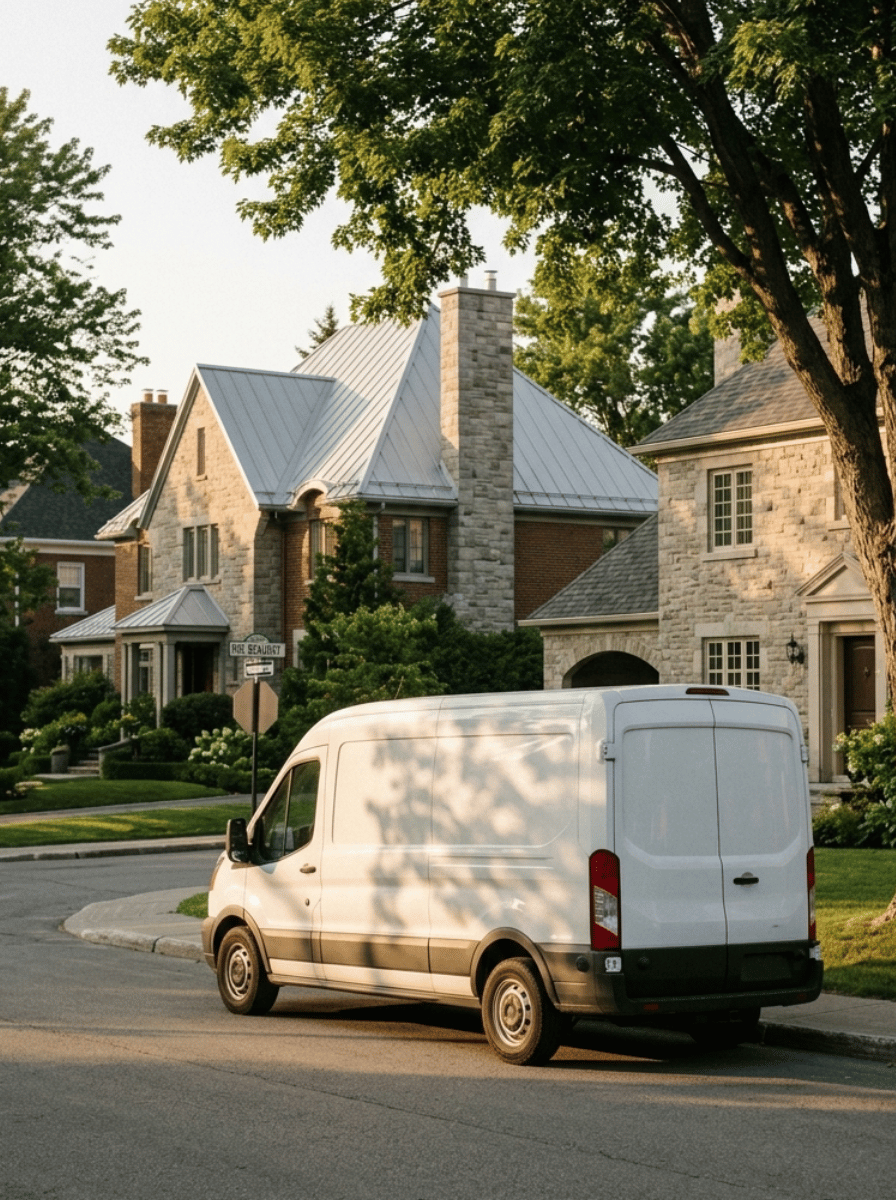
Thorough inspection, treatment targeted at the queen, and a written guarantee handed to you before the work starts. Free quote and fixed price, in unmarked vehicles for full discretion, everywhere in Quebec, from Greater Montreal to the Laurentians and the Outaouais region.